Agile Team Autonomy: 2026 Research on Mastery & Purpose
Introduction
At some point in the last few years, most organisations discovered that telling people they were 'empowered' was a lot easier than actually empowering them. A team gets called self-organising. A Confluence page goes up about psychological safety. And then the same three people make all the decisions and everyone else waits to be told what to do.
Genuine autonomy in teams, designed into the structure of how work gets done rather than announced at an all-hands, is consistently one of the strongest predictors of both wellbeing and performance. A 2021 meta-analysis of 69 studies covering more than 6,000 teams found that real decision authority at the team level drives measurable improvements in how teams function and how they perform, through both better task execution and stronger working relationships.
[1] But autonomy on its own is not the mechanism. What it does is create the conditions for something more interesting.
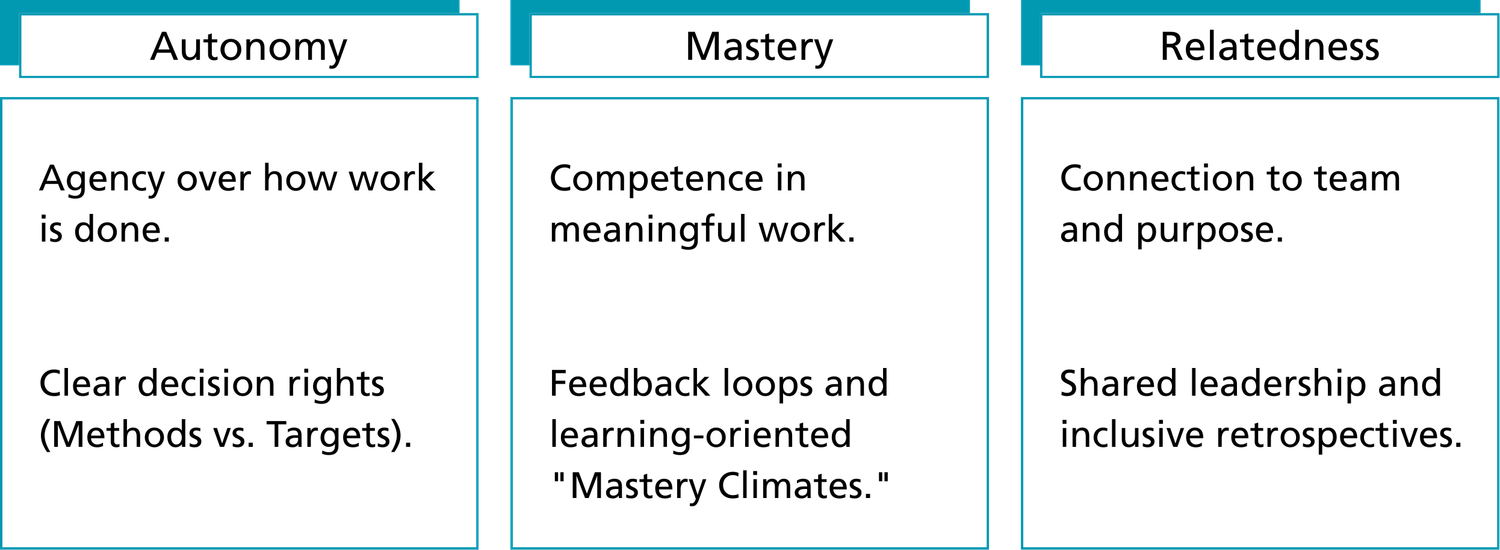
Autonomy, Mastery, and Relatedness at a glance
What the Research Is Actually Measuring
The framing that holds up best across the evidence is Self-Determination Theory (SDT), which identifies three basic psychological needs: autonomy (agency over your work), competence/mastery (getting better at something that matters), and relatedness (feeling genuinely connected to the people and purpose around you).
A 2026 meta-analysis of 192 workplace studies covering more than 93,000 participants found that leadership behaviours which support all three needs produce strong positive effects on engagement, satisfaction, wellbeing, and performance, and negative effects on burnout and turnover intentions.[3]
These are not small effects found in niche settings. They hold across sectors, countries, and types of work. Which makes it a design problem, not a culture problem. You do not fix this with a values workshop. You fix it by changing what the team's structure actually allows people to do.
Agile Practices as a Delivery Mechanism for Wellbeing
A two-wave survey of 260 agile team members found that higher levels of core agile practices, including self-organised teamwork, iterative planning, and retrospectives, predicted lower job demands such as workload and interruptions, and higher job resources including autonomy, peer support, and feedback.[2]
Through these work characteristics, agile practices indirectly reduced emotional fatigue and increased engagement. Effects held even after controlling for other high-performance work systems, suggesting specific agile practices add value beyond generic good management.
This matters for coaches and leaders who are sometimes asked to justify agile adoption on human terms rather than just delivery speed. The evidence is there. Well-implemented agile practices reduce the conditions that lead to burnout and increase the conditions that drive engagement. The implementation quality is what determines whether any of this actually happens.
The Job Demands-Resources Model: A Practical Frame
The Job Demands-Resources model, developed by Bakker, Demerouti and colleagues, offers a useful lens for delivery leaders. High job demands, such as workload, role conflict, and time pressure, reliably predict burnout. Job resources, including autonomy, feedback, social support, and development opportunities, reliably predict engagement and buffer the impact of demands on strain.[5]
The critical insight is that resources are most protective precisely when demands are high. In other words, designing teams with high autonomy, strong feedback loops, and genuine support is most valuable in demanding environments, which describes most agile delivery contexts.[5] Reducing demands alone is not the goal. Creating high-challenge, high-resource conditions is.
Research exploring why this works at the individual level found that job resources such as job control and social support reduced burnout primarily by meeting the three psychological needs identified in SDT: autonomy, competence, and relatedness.[6] The structural features of the role get under the skin through people's internal experience of agency, mastery, and connection.
The Problem With High Engagement in the Wrong Climate
One of the more counterintuitive findings in this space comes from a two-wave study of 1,081 employees that found an inverted U-shape relationship between engagement and burnout: very high engagement was associated with higher burnout, consistent with resource depletion when effort is not balanced with recovery.[4]
The moderating variable was climate. A performance-oriented climate characterised by social comparison and pressure to outperform others amplified the engagement-burnout link. A mastery climate, focused on learning, cooperation, and effort, reduced cynicism and weakened the risk of high engagement tipping into burnout.[4]
Most people think "High Engagement = Good." But actually "High Engagement + Bad Climate = Burnout."
For agile coaches specifically, this is worth sitting with. A highly engaged team in a team-versus-team performance culture is at meaningful risk. The same team in a mastery-oriented, learning-focused environment is likely to sustain that energy over time. The climate around the work is part of the design, not background noise.
Autonomy Needs to Be Designed, Not Announced
A conceptual analysis of different forms of autonomy found that not all types have uniformly positive effects. Scheduling autonomy, for example, can in some contexts be negatively associated with motivation when it adds complexity without adequate support.[10]
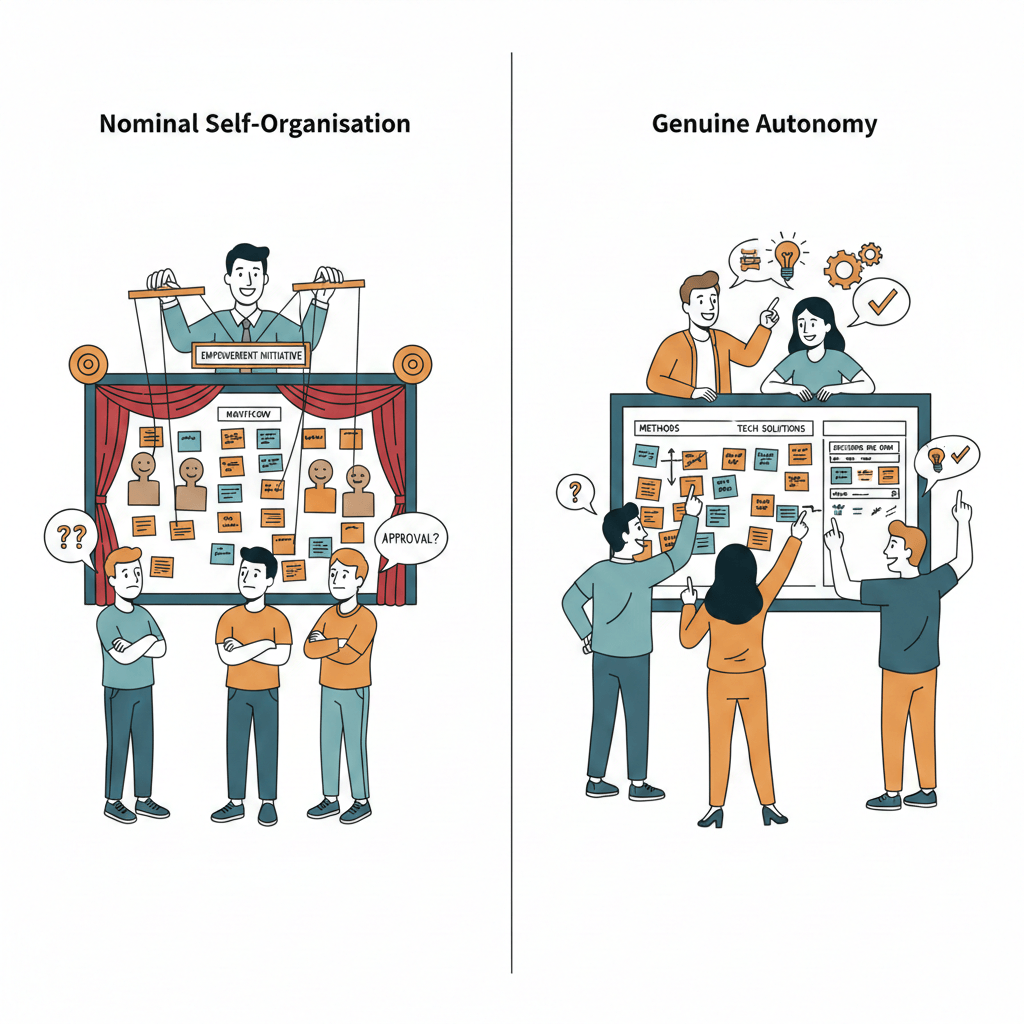
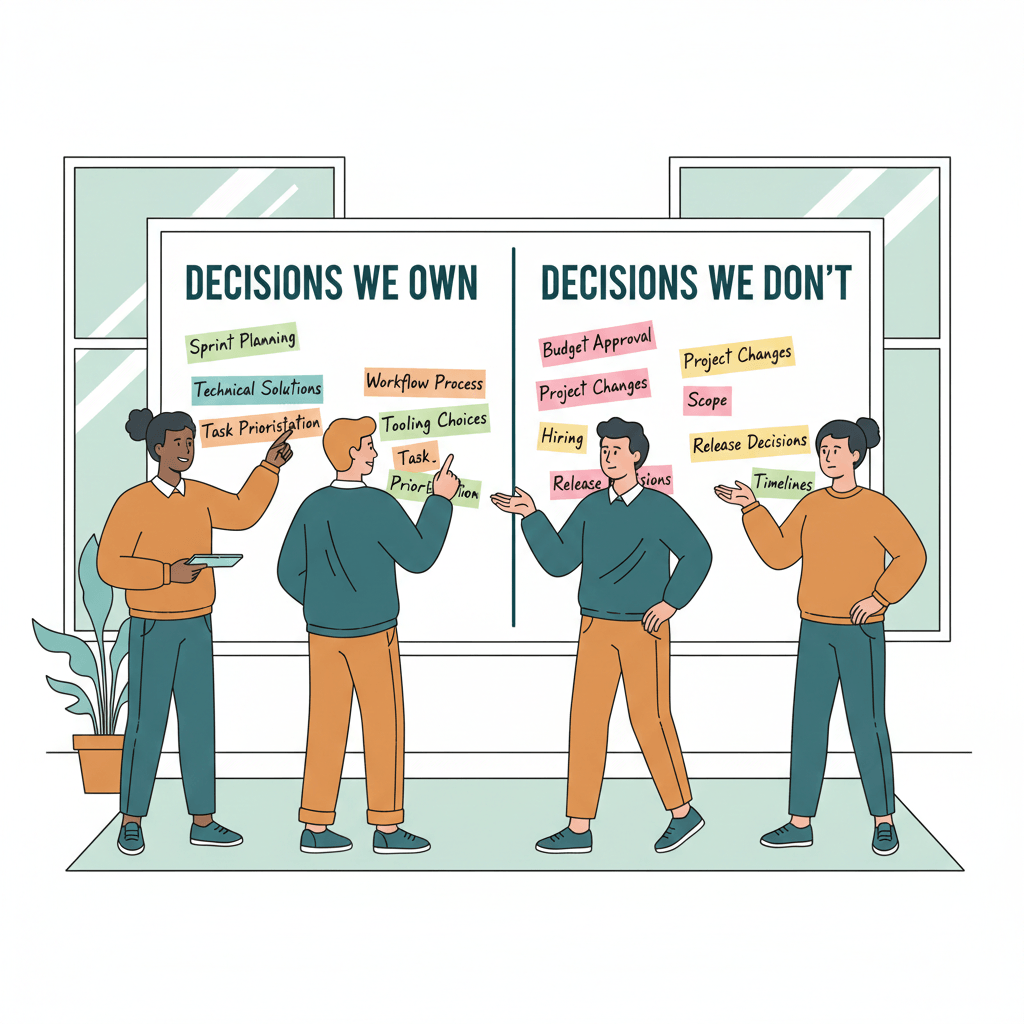
The recommendation is to design autonomy at the task level: clarifying what decisions teams genuinely own, such as methods, technical solutions, and workflow, versus what remains constrained, rather than treating autonomy as an all-or-nothing grant.
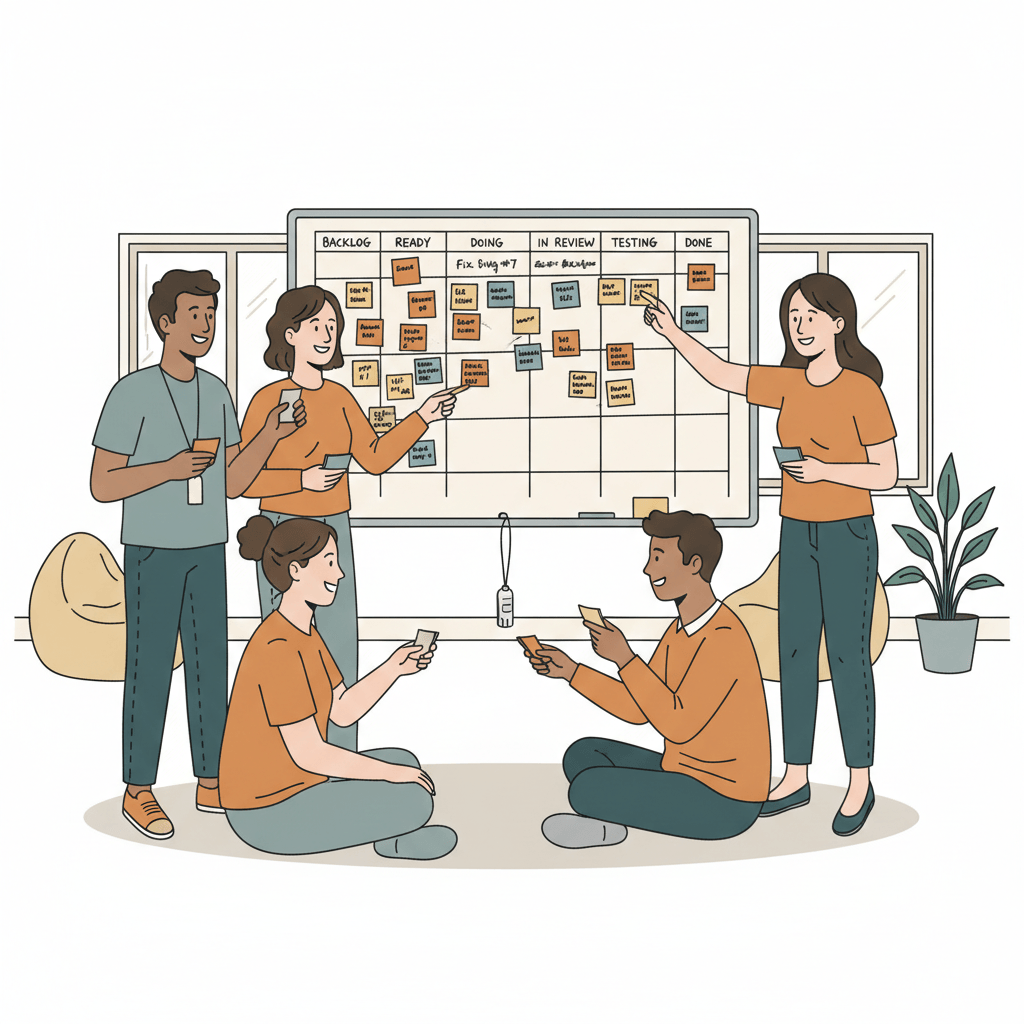
An empirical case study of agile and lean software teams found that concrete process designs, including Kanban boards, retrospectives, daily stand-ups, and iterative planning, embed autonomy and mastery in day-to-day work rather than leaving them as abstract aspirations.[8] The board on the wall is not decoration. It is a mechanism for shared ownership.
Empowerment and Shared Leadership
A cross-sectional survey of 42 healthcare teams found that team empowerment was positively related to shared leadership, and shared leadership in turn was positively associated with team performance, mediating the empowerment-performance relationship.[7] Relationship conflict weakened the positive impact of shared leadership on performance, highlighting that psychological and relational conditions are prerequisites, not afterthoughts.
The practical implication: involving team members in decision-making, providing cross-functional exposure, and creating inclusive processes are not soft skills initiatives. They are the structural conditions under which shared leadership, and therefore better performance, can emerge.
Why Individual Resilience Programmes Miss the Point
A 2025 systematic review of the employee wellbeing literature concluded that work design and leadership, including autonomy, participation, and supportive climates, are the central levers for wellbeing improvement, and called for interventions that integrate structural job redesign with leadership development rather than relying on individual-level resilience or wellness programmes.[9]
The individual resilience model places responsibility on the person to cope better with conditions that the organisation created. The work design model places responsibility on the organisation to create conditions that do not require people to cope. Both are in use. The evidence favours one of them.
What This Means for Leaders and Coaches
The practical conclusions from this body of evidence are fairly consistent:
Autonomy that is real, meaning teams genuinely own their methods and decisions, not just their task order, produces measurable improvements in both performance and wellbeing. Nominal self-organisation does not.
Agile practices work partly because they systematically build the resources, including feedback, peer support, and control over workload, that protect against burnout and drive engagement. Practices implemented without intent produce weaker effects.
The climate a leader creates around highly engaged teams matters as much as the engagement itself. Learning and mastery orientations sustain performance. Competitive, comparison-heavy climates erode it.
Job redesign and leadership development have more durable effects on wellbeing and performance than standalone wellness programmes. The structural conditions of work are the primary intervention point.
Autonomy should be designed specifically: which decisions does the team own, which are constrained, and what support exists to make the autonomous decisions well?
Key Research Insights
Autonomy Type Matters: Task-level autonomy is superior to scheduling autonomy (Workitects, 2020).
The Engagement Trap: Very high engagement predicts burnout in competitive climates but not in mastery climates (Nerstad et al., 2019).
The Wellbeing Lever: Work design outperforms individual resilience programmes for long-term health (Pandey, 2025).
FAQs
1. What does 'team autonomy' actually mean in an agile context?
Genuine team autonomy means teams have real decision authority over how they plan their work, which methods they use, how they solve technical problems, and how they organise their workflow. It is distinct from nominal self-organisation, where teams are called self-organising but continue to seek approval for most substantive decisions. Research consistently shows the former predicts performance and wellbeing improvements; the latter does not.
2. How do autonomy, mastery, and purpose connect to agile delivery outcomes?
Self-Determination Theory identifies autonomy, competence (mastery), and relatedness (purpose and connection) as the three basic psychological needs that, when met, drive sustained engagement and performance. Agile practices, when implemented well, systematically provide feedback (supporting mastery), decision ownership (supporting autonomy), and team cohesion and mission clarity (supporting relatedness). The delivery outcomes follow from meeting these needs, not from the practices themselves.
3. Why can high engagement lead to burnout in some teams?
A field study of more than 1,000 employees found a curvilinear relationship between engagement and burnout: at very high levels of engagement, burnout risk increased, consistent with resource depletion when effort is not balanced with recovery. The key moderator was the motivational climate. Performance-oriented climates, those emphasising social comparison and outperforming others, amplified the risk. Mastery-oriented climates, focused on learning and cooperation, reduced it.
4. What is the Job Demands-Resources model and why does it matter for agile teams?
The JD-R model proposes that high job demands predict burnout, while job resources such as autonomy, feedback, and social support predict engagement and buffer the impact of demands on strain. For agile teams operating in high-demand environments, this means the design question is not how to reduce demands but how to ensure resources are high enough to make demanding work sustainable. Retrospectives, WIP limits, peer support structures, and genuine feedback loops are resource-building mechanisms.
5. Is there a risk that giving teams too much autonomy backfires?
Yes, in specific circumstances. Research shows that some forms of autonomy, particularly scheduling autonomy, can be negatively associated with motivation when they add complexity without adequate support. The recommendation is to design autonomy at the task level, specifying which decisions teams genuinely own and ensuring the support structures exist to make those decisions well, rather than treating autonomy as a binary grant.
6. How do agile retrospectives contribute to team wellbeing?
Survey research found that retrospectives, as part of a broader set of agile practices, predicted higher job resources and lower job demands, which in turn reduced emotional fatigue and increased engagement. The mechanism is that retrospectives give teams ongoing influence over their conditions of work: they surface problems, generate solutions, and build the shared competence and relatedness that sustain performance over time.
7. What should UK-based agile coaches focus on to improve team sustainability?
The evidence points to three priorities: designing genuine decision authority into team structures rather than labelling teams as self-organising; actively shaping a mastery-oriented climate rather than a performance-comparison one; and treating job redesign and leadership behaviour as the primary wellbeing interventions rather than delegating wellbeing to individual resilience programmes or standalone wellness offerings.
8. How does shared leadership relate to team empowerment?
Research on healthcare teams found that team empowerment predicts shared leadership, and shared leadership in turn predicts team performance. The relationship is mediated, meaning empowerment alone is not enough: teams need inclusive decision-making processes, cross-functional capability, and low relationship conflict to convert empowerment into shared leadership and shared leadership into results.
9. Do these principles apply across different sectors and countries?
The 2026 meta-analysis on Self-Determination Theory and workplace outcomes covered 192 studies across multiple sectors and countries and found that need-supportive leadership and autonomous motivation were associated with better outcomes consistently across contexts, with some variation in effect size. The principles are robust and generalisable, with stronger effects observed in corporate and higher-GDP contexts.
10. Where should a delivery leader start if they want to build a more sustainable team?
A productive starting point is a structured audit of what decisions the team genuinely owns versus what requires approval. Map the autonomy the team actually has against the autonomy they nominally have. Then examine the motivational climate: does the team's environment reward learning and cooperation, or does it emphasise comparison and individual performance? Both are adjustable. Both have measurable effects on sustainability.
References
1. Ji, R., Neubert, E. M., & Gonzalez-Mulé, E. (2021). Putting the team in the driver's seat: A meta-analysis on the what, why, and when of team autonomy's impact on team effectiveness. Personnel Psychology. https://onlinelibrary.wiley.com/doi/abs/10.1111/peps.12468
2. Rietze, S., & Zacher, H. (2022). Relationships between agile work practices and occupational well-being: The role of job demands and resources. International Journal of Environmental Research and Public Health, 19(3), 1258. https://pmc.ncbi.nlm.nih.gov/articles/PMC8835693/
3. Hagger, M. S., & McAnally Star, K. (2026). Self-Determination Theory and workplace outcomes: A meta-analysis. Stress and Health, 42(1), e70151. https://pmc.ncbi.nlm.nih.gov/articles/PMC12887546/
4. Nerstad, C. G. L., Wong, S. I., & Richardsen, A. M. (2019). Can engagement go awry and lead to burnout? The moderating role of the perceived motivational climate. International Journal of Environmental Research and Public Health, 16(11), 1979. https://pmc.ncbi.nlm.nih.gov/articles/PMC6603860/
5. Bakker, A. B., Demerouti, E., & Sanz-Vergel, A. I. (2014). Burnout and work engagement: The JD-R approach. Annual Review of Organizational Psychology and Organizational Behavior, 1, 389-411. https://www.isonderhouden.nl/doc/pdf/arnoldbakker/articles/articles_arnold_bakker_348.pdf
6. Fernet, C., Austin, S., & Vallerand, R. J. (2013). How do job characteristics contribute to burnout? Exploring the distinct mediating roles of perceived autonomy, competence, and relatedness. European Journal of Work and Organizational Psychology, 22(2), 123-137. https://selfdeterminationtheory.org/SDT/documents/2013_FernetEtAl.EJWOP.pdf
7. (2025). The interplay of team empowerment, shared leadership, and relationship conflict: Evidence from healthcare teams. Strategy & Leadership. https://www.emerald.com/insight/content/doi/10.1108/sl-10-2024-0118/full/html
8. (2013). Attaining high-performing software teams with Agile and Lean practices: An empirical case study. ArXiv preprint arXiv:1311.6933. http://arxiv.org/pdf/1311.6933.pdf
9. Pandey, A. (2025). A systematic literature review on employee well-being. Personality and Individual Differences. https://www.sciencedirect.com/science/article/pii/S0001691825003932
10. Workitects (2020). Job design and autonomy: A task-level approach. Workitects report. https://www.workitects.be/sites/default/files/media/2020-06/Job_design_autonomy_task-level_approach_0.pdf
HEY, I’M JO
I help women build habits that hold up in real life and design lives that feel like theirs. I write about brains, systems, identity, and why most self-help advice doesn't land for the women who need it most. Most of what I share here comes from research, the women I work with, and my own ongoing experiment of practising what I preach. I believe the problem is almost never you.
People blame themselves for struggles that are often created by the environments they’re living in.
This work is about taking responsibility for how we live, while also questioning the defaults we’ve inherited.
Choosing deliberately how we participate in it.
Here you’ll find small tools you can use today, plus a few deeper dives. If you want guidance in diving deeper, have a look around the website and see what speaks to you.
Latest Articles
THE TRAVELLING COACH
Sarah "Jo" Will
C/ Jose Manaut Viglietti 3
46024 Valencia
Quick links
Tools, stories & prompts
Join the Mind the Mess newsletter for real stories, practical tools,
and thoughtful prompts to help you grow.