Circles of Influence: Where to Put Your Energy When Everything Feels Heavy
I've been reading the news more than is good for me lately.
The state of the world has a way of sitting in the background of everything, a low hum of anxiety that's hard to name and harder to put down. I don't think I'm alone in this. When I ask the women I work with what's been draining their energy, the answer is rarely one specific thing. It's a feeling of being pulled in too many directions at once, most of which they can't do anything about.
When I notice I'm carrying more worry than is useful, I come back to a simple model. Stephen Covey wrote about it in The 7 Habits of Highly Effective People, but versions of the same idea appear in Stoic philosophy, Buddhist teaching, and cognitive behavioural therapy. The fact that it keeps surfacing across centuries and disciplines suggests something true about how humans relate to worry.
The three circles
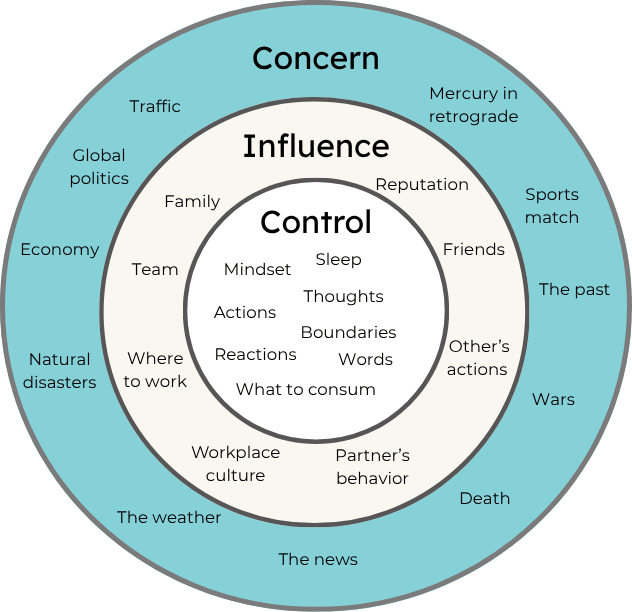
The model is three concentric circles, each representing a different relationship between you and the things occupying your attention.
Control is what you can directly act on. Your choices, your environment, your immediate actions. This circle is smaller than most of us would like, but it's real and it's yours. Whether you open your phone before you've had a cup of tea. What you eat. How you move. Whether you call that friend back.
Influence is what you can affect but not determine. How you show up in conversations. What you choose to support or withdraw from. The people around you. Energy here isn't wasted, but it requires accepting that the outcome isn't guaranteed. You can be a good parent without controlling how your children turn out. You can contribute to a healthier team culture without single-handedly fixing a dysfunctional organisation.
Concern is what you care about but cannot change. The news. Other people's decisions. Political systems. Global crises. Valid things to hold. Heavy things to carry indefinitely.
Covey's original insight was that effective people spend most of their energy in the control and influence circles. Their influence actually grows as a result, because they're working on what they can affect rather than exhausting themselves on what they can't. People who spend most of their energy in the concern circle tend to feel increasingly helpless, which shrinks their sense of agency over time.
Why we default to the concern circle
Most of us, when the world feels like too much, are living almost entirely in the concern circle. Absorbing, worrying, scrolling, feeling helpless and wondering why we're exhausted.
There's a reason for this. The brain's negativity bias means we pay more attention to threats than opportunities. Psychologist Roy Baumeister's research on this phenomenon found that negative events carry roughly twice the psychological weight of positive ones. From an evolutionary perspective, this made sense: noticing danger was more important than noticing beauty. But in a world where your phone delivers a continuous stream of global crises directly to your nervous system, that same bias means the concern circle receives a disproportionate share of your attention.
Social media compounds this. Research on "doomscrolling" has found that passive consumption of negative news is associated with increased anxiety and a reduced sense of personal agency. You absorb the problems of the world without any corresponding sense that you can act on them. The concern circle expands. The control circle feels irrelevant by comparison.
For women specifically, there's an additional layer. The mental load of managing other people's needs, schedules, and emotions means the influence circle is often already overstretched. When you're spending significant cognitive resources tracking everyone else's wellbeing, the energy left over for your own control circle can be minimal. You end up managing everything except the things that are actually, fully yours.
The practice
The practice isn't to stop caring. Concern is often a sign that your moral compass is functioning well. The problem is when concern absorbs energy that was meant for action.
The shift is noticing where your energy is actually going and gently moving more of it back toward what's in your hands. This sounds simple because the model is simple. The difficulty is in the noticing, because the concern circle doesn't announce itself. It arrives disguised as staying informed, being responsible, caring about the world.
A useful question when you feel stuck or drained: which circle am I actually operating in right now?
Often the answer reveals that you're trying to control outcomes that sit in the influence circle, and then feeling like you've failed when you can't. I see this constantly in habit design. Women beating themselves up for not sleeping better, for not being more consistent, for not having the energy they think they should have. Most of that frustration is aimed at things that were never fully in their control to begin with.
You can put your trainers by the door (control). You can't guarantee you'll feel like running (influence). You can make a meal plan (control). You can't guarantee you'll have the capacity to follow it on a day when everything else falls apart (influence). Knowing which circle you're operating in determines whether you respond with design or with self-blame. One of those is useful. The other is a trap.
The 8th century Buddhist scholar Shantideva arrived at something similar when he wrote: "Why be unhappy about something if it can be remedied? And what is the use of being unhappy about something if it cannot be remedied?" Different tradition, different century. Same observation about where worry belongs and where it doesn't.
How to use this
When you notice you're carrying more than feels manageable, try mapping what's on your mind to the three circles. You don't need a worksheet. A few minutes of honest sorting is enough.
What's actually in your control right now? What can you influence but not determine? What are you worrying about that you genuinely cannot change?
Then ask: what's one thing in your control circle this week that you've been neglecting while your attention was elsewhere?
The answer is usually small. That's fine. The control circle is small. That's what makes it manageable, and what makes it yours.
HEY, I’M JO
I help women build habits that hold up in real life and design lives that feel like theirs. I write about brains, systems, identity, and why most self-help advice doesn't land for the women who need it most. Most of what I share here comes from research, the women I work with, and my own ongoing experiment of practising what I preach. I believe the problem is almost never you.
People blame themselves for struggles that are often created by the environments they’re living in.
This work is about taking responsibility for how we live, while also questioning the defaults we’ve inherited.
Choosing deliberately how we participate in it.
Here you’ll find small tools you can use today, plus a few deeper dives. If you want guidance in diving deeper, have a look around the website and see what speaks to you.
Latest Articles
THE TRAVELLING COACH
Sarah "Jo" Will
C/ Jose Manaut Viglietti 3
46024 Valencia
Quick links
Tools, stories & prompts
Join the Mind the Mess newsletter for real stories, practical tools,
and thoughtful prompts to help you grow.